
Wiki
Wiki Archive
- 1Sep 2026
- 1Apr 2026
- 2May 2025
- 1Feb 2014
- 1Dec 2013
- 1Oct 2011
- 1Nov 2009
- 1Oct 2009
- 1Sep 2009
- 1Mar 2009
- 1Feb 2009
- 1Nov 2008
- 1Sep 2008
- 1Jul 2008
- 2Apr 2008
- 2Mar 2008
- 1Feb 2008
- 1Jan 2008
- 4Dec 2007
- 3Nov 2007
- 2Oct 2007
- 4Aug 2007
- 1Jul 2007
- 3Jun 2007
- 1May 2007
- 4Apr 2007
- 2Mar 2007
- 2Feb 2007
- 1Jan 2007
- 6Dec 2006
- 4Nov 2006
- 3Oct 2006
- 4Sep 2006
- 12Aug 2006
- 8Jul 2006
- 6Jun 2006
- 3May 2006
- 3Apr 2006
- 2Mar 2006
- 4Feb 2006
- 2Jan 2006
- 3Dec 2005
- 2Nov 2005
- 12Oct 2005
- 1Sep 2005
- 3Jul 2005
Wiki, Feb 2007
2007 International Symposium on Wikis
Wikis at Work in the World:
Open, Organic, Participatory Media for the 21st Century
October 21-23, 2007, Montreal, CanadaCo-located with ACM OOPSLA 2007
In cooperation with ACM SIGWEB See http://www.wikisym.org/ Archived * Peer Reviewed * ACM Sponsored
OVERVIEW
The 2007 International Symposium on Wikis brings together wiki researchers, practitioners, and users. The goal of the symposium is to explore and extend our growing community. The symposium has a rigorously reviewed research paper track as well as plenty of space for practitioner reports, demonstrations, and discussions. Anyone who is involved in using, researching, or developing wikis is invited to WikiSym 2007! We recognize the online world is always evolving, and we also welcome contributions which are about other online media consistent with the wiki philosophy of being open, organic and participatory. We are seeking submissions for- research papers (long and short): due 7 May 2007
- workshops: due 7 May 2007
- panels: due 7 May 2007
- posters: due 9 July 2007
- demonstrations: due 9 July 2007
- business, marketing, law
- communications and media studies
- computer science, human-computer interaction
- history, political science, geography
- information and library science
- linguistics, discourse analysis, language studies
- natural sciences, medicine
- wiki technologies and implementations
- wiki in the workplace; for business use
- wiki as social software for collaboration and work group processes
- wiki user experiences, usability, discourse analysis
- wiki for non-text media (images, video, audio) and spatial systems
- wiki content dynamics and evolution, wiki metrics
- wiki journalism; wiki archiving
- wiki reputation systems, quality assurance processes
- wiki administration, processes, dealing with abuse
- wiki scalability, social and technical
- wiki and the semantic web, knowledge management, tacit-knowledge
- wikis for specific domains (education, genomics, politics, etc.)
- wikis written by and for small audiences (ex: family wikis)
- wiki legal issues (copyright, licensing)
- wiki translation and multilingual wiki content
SUBMISSION DETAILS
Research papers will be reviewed by the Program Committee to meet rigorous academic standards of publication. Research papers are expected to advance the state of the art by describing substantiated new research or novel technical results or by reporting on significant experience (including case studies) or experimentation. They will be reviewed both with respect to conceptual quality and clarity of presentation. Note that authors of accepted papers are expected to attend the conference and present the paper, otherwise publication will be canceled. Accepted research papers will be provided as part of the conference proceedings. They will be put into the ACM Digital Library and can be referenced as papers that appeared in the "Proceedings of the 2007 International Symposium on Wikis (WikiSym 2007)". We invite full papers (recommended length of 10 to 15 pages with maximum of 20 pages, and a 30 minute presentation time) and short papers (maximum 6 pages, with a 15 minute presentation time). Papers should use the ACM SIG Proceedings Format, see: http://www.acm.org/sigs/pubs/proceed/template.html Workshop and Panels submissions will be reviewed and selected for their interest to the community. A submission should consist of two pages describing what you intend to do and how you meet this criterion. It should include a 100-word abstract and one-paragraph bios of all people relevant to the submission. Workshops will be allocated a half-day or a full-day and a room of their own (depending on your request). Panels will be given a 90 minutes time slot and a room of their own. Poster submissions will be reviewed on their merits and may describe research projects or experience reports. A submission should consist of two page extended abstract outlining the content of the poster. Successful applicants will be invited to bring a poster for display at the symposium. Posters must be flat and within 1mx2m in size. Demos will be reviewed based on their relevance to the community. A submission should be one page in length, with a title, a short description of the demo, as well as a description of any special technical needs you may have (ex: wireless connectivity). Please submit your papers or proposals in PDF format by the respective deadline through our submission system, which will be available through the WikiSym website. Questions should be directed respectively at papers@wikisym.org (research papers and practitioner reports), workshopsandpanels@wikisym.org (workshops and panels), or demosandposters@wikisym.org (posters and demos).SYMPOSIUM LOGISTICS
The 2007 International Symposium on Wikis will be held at the Palais des Congrès in Montreal, Canada, October 21-23, 2007. A special hotel rate has been negotiated at the Hyatt Regency Montreal. WikiSym 2007 will be co-located with the ACM OOPSLA 2007 conference, and participants may register for the symposium alone, or may jointly register for WikiSym and OOPSLA 2007. Registration is handled through the ACM OOPSLA website: http://oopsla.org/ If you have any questions, please contact Alain Desilets through chair@wikisym.org.SYMPOSIUM COMMITTEE
- Alain Désilet, NRC-CNRC, Canada (Symposium Chair)
- Robert Biddle, Carleton University, Canada (Program Chair)
- Phoebe Ayers, U. of California Davis, USA (Wikimedia Liaison and Publicity)
- Angela Beesley, Wikia / Wikimedia, USA (Posters and Demos Chair)
- Mark Bernstein, Eastgate Systems, USA (Panels and Workshops Chair)
- Ward Cunningham, Eclipse Foundation, USA (Honorary Chair)
- Ted Ernst, Open Space World (Open Space Chair)
- Andrea Forte, Georgia Institute of Technology, USA (Publicity Chair)
- Dirk Riehle, SAP, USA (Treasurer and Corporate Sponsorships)
- Peter Thoeny, TWiki.org and StructuredWikis LLC, USA (Web Master)
Bereits vor längerem wurde ich von verschiedenen Seiten darauf aufmerksam gemacht, dass es mit Ed.wiki (Biblionetz:w01999) eine speziell für Bildungszwecke (wiki in education, Biblionetz:w01331) entwickelte Wiki-Engine gibt. Nun habe ich mir endlich Zeit genommen, Ed.wiki etwas genauer anzuschauen.
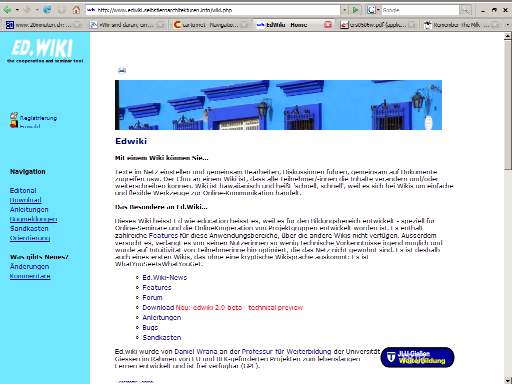
Das Besondere an ed.wiki...
Dieses Wiki wurde speziell für Online-Seminare und die Online-Kooperation von Projektgruppen entwickelt und enthält zahlreiche Features für diese Anwendungsbereiche, über die andere Wikis nicht verfügen. Ed wie education heisst es, weil es für den Bildungsbereich entwickelt worden ist. Dass es von seinen Nutzerinnen so wenig technische Vorkenntnisse wie möglich verlangt, ist eines der Hauptanliegen. Und das beste: Es ist eines der ersten Wikis, das ohne eine kryptische Wikisprache auskommt. Es ist WYSIWYG.
Dieses Wiki wurde speziell für Online-Seminare und die Online-Kooperation von Projektgruppen entwickelt und enthält zahlreiche Features für diese Anwendungsbereiche, über die andere Wikis nicht verfügen. Ed wie education heisst es, weil es für den Bildungsbereich entwickelt worden ist. Dass es von seinen Nutzerinnen so wenig technische Vorkenntnisse wie möglich verlangt, ist eines der Hauptanliegen. Und das beste: Es ist eines der ersten Wikis, das ohne eine kryptische Wikisprache auskommt. Es ist WYSIWYG.
Besondere Anforderungen an Bildungs-Wikis?
Es ist eine spannende Frage, welche besonderen Eigenschaften ein Wiki für Aus- und Weiterbildungswecke haben sollte. Auf der Liste der Ed.wiki-Features lassen sich verschiedene Anliegen erkennen:- Einfache Benutzung: Verschiedene Ed.wiki-Eigenschaften sollen eine besonders einfache Nutzung ermöglichen (WYSIWYG-Editor, Verstecken von Features usw.)
- Leitungsfunktionen: Gewisse Ed.wiki-Eigenschaften sollen den Lehrenden die Wiki-Nutzung erleichtern (Teilnehmerinnenverwaltung)
- Sichtbarmachfunktionen: Lehrende und Lernende sollen sehen können, was im Wiki passiert ist (Statistik-Funktionen, Portfolio)
Make or Configure?
Während mir gewisse dieser Anliegen tatsächlich bildungsspezifisch scheinen, sind andere auch für Nicht-Bildungs-Wikis wünschenswert. Mir stellt sich angesichts von Ed.wiki die Frage, ob das Entwickeln einer eigenen Wiki-Engine für Bildungszwecke sinnvoll und vom Aufwand her machbar ist. Mir gefällt das "look and feel" von ed.wiki, es ist wirklich intuitiv und un-techie-haft, was die Akzeptanz bei Lehrenden und Lernenden sicherlich erhöhen wird. Für meine Zwecke fehlen aber dem Ed.wiki zahlreiche Eigenschaften, die nicht bildungsspezifisch sind (z.B. E-Mail-Notification, RSS-Feeds, automatische Sperrfunktion zur Verhinderung paralleler Schreibkonflikte) und ich frage mich, ob die Entwickler die Ressourcen finden werden, mit der technischen Entwicklung (neue Browser, mehr AJAX, Stopfen von Sicherheitslücken usw.) Schritt zu halten. Die Alternative zum Weg make, den ed.wiki beschritten hat, lautet configure: Man nehme eine grosse, bekannte Wiki-Engine (vermutlich Mediawiki oder TWiki) und versuche diese durch Skins und Plugins für Bildungszwecke zu optimieren. Vorteil: Man muss sich weniger um die Weiterentwicklung allgemeiner Features der Wiki-Engine kümmern. Nachteil: Man muss mit evtl. für Bildungszwecke suboptimalen Design-Entscheiden (z.B. fehlende Einfachheit) leben können. Konkret: Ich würde gerne Ressourcen ins Anpassen von TWiki für Aus- und Weiterbildung investieren können. P.S.: Wie klein die Welt doch ist:
Ed.wiki wurde im Rahmen von BLK-geförderten Projekten der Professur für Weiterbildung der Universität Giessen zum lebenslangen Lernen von Daniel Wrana entwickelt und ist unter der GPL lizensiert und damit frei verfügbar.
Erst jetzt ist mir bewusst geworden, dass Ed.wiki somit unter der Leitung unseres neuen PH-Direktors Hermann Forneck entwickelt wurde.
Kontakt
- Beat Döbeli Honegger
- Plattenstrasse 80
- CH-8032 Zürich
- E-mail: beat@doebe.li
About me
Social Media


This page was cached on 08 Oct 2026 - 07:25.